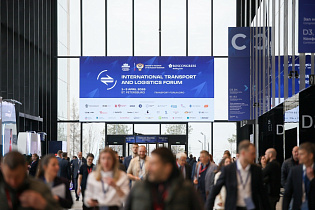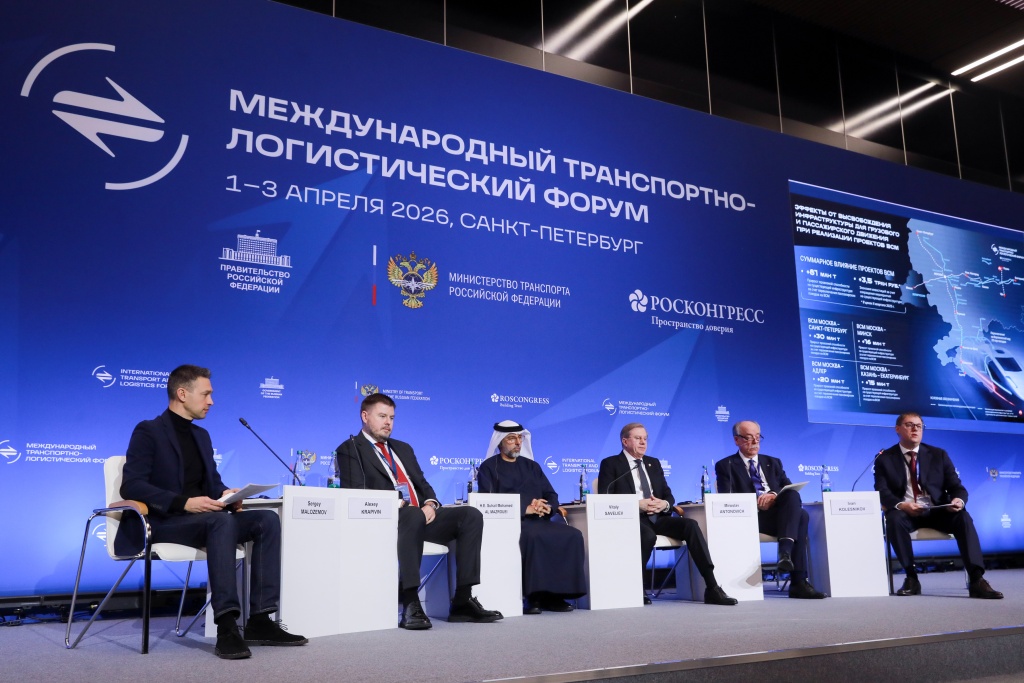
The roundtable discussion ‘High-Speed Rail: Pinnacle of Speed and Passenger Comfort’ was held at the International Transport and Logistics Forum, which is taking place at the ExpoForum Convention and Exhibition Centre in St. Petersburg from 1 to 3 April. On hand to discuss the creation of Russia’s first high-speed railway were Deputy Prime Minister of the Government of the Russian Federation Vitaly Savelyev and Minister of Transport of the Russian Federation Andrei Nikitin.
High-speed railways are now a central part of the technological development of Russia’s transport infrastructure. A high-speed rail network is being developed with the use of advanced engineering and digital solutions, from next-generation high-speed rolling stock and specialized infrastructure to modern traffic management systems for their operation.
According to Savelyev, the President of the Russian Federation has called for five high-speed railway lines to be built to connect Moscow to St. Petersburg, Minsk, Adler, Ryazan, and Yekaterinburg via Kazan. A total of 70,000 km of high-speed railway line has already been built around the world, 70% in China. “Every year, China builds some 3,000 km of high-speed railway and accommodates 4 billion rides. China is expected to reach 60,000 km of high-speed railway by 2030,” the Deputy Prime Minister of the Russian Federation said.
Savelyev went on to say that the world’s most advanced technological solutions had been incorporated into the design for Russia’s first high-speed railway, which will reduce travel time between the metropolitan areas of Moscow and St. Petersburg to 2 hours and 15 minutes. “Project implementation has entered an important new stage, with construction underway on the 129-kilometre section between Zelenograd and Tver that will serve as a testing ground for Russia’s first high-speed train.”
“Employing more than 21,000 construction workers and 10,000 pieces of equipment, the construction of the high-speed railway is proceeding on an unprecedented scale in the unique natural and climatic conditions of the North. Many of the technical solutions are being applied to the construction of transport infrastructure for the very first time,” Savelyev said.
The high-speed railway line is built on slab track, with a unique concrete slab capable of withstanding temperature fluctuations from +50°C to -50°C replacing the traditional sleepers and ballast. The designs of the bridges and overpasses are also unique and employ 32-metre monolithic beams weighing 700 tonnes, ensuring speed year-round.
Savelyev also spoke about the trains being developed for the high-speed railway and manufactured at the Sinara Group’s Ural Locomotives Plant, with thirty-six new subsystems of over 15,000 components, assemblies, and parts.
According to Andrei Nikitin, the high-speed rail project is one of modern Russia’s most significant scientific projects, and a special degree programme in high-speed railway engineering has already been approved. Graduates will acquire a solid foundation in engineering and an in-depth knowledge of mathematics, physics, and mechanics to go with a good grasp of modern software tools for work with digital models and simulators as they contribute to the development of new technologies. Prime examples are the design of the track itself, which must accommodate speeds of up to 400 km/h, and the rolling stock, which requires an understanding of the aerodynamics of high-speed trains and the design of high-voltage traction system equipment. Finally, an important challenge remains in being able to ensure cybersecurity and manage technical risks in real time.
“More than 100,000 specialists will be needed to keep Russia’s entire high-speed railway development programme running. In 2024, the High-Speed Railway Academy, an advanced engineering school, was established at the Russian University of Transport to train specialists capable of designing, building, and operating high-speed rail systems,” Nikitin said.
The High-Speed Rail Academy was originally established to combine education with science and industry but also oversees the technical aspects of the project, already reviewing over 8,000 volumes of project documentation, issuing more than 4,000 recommendations for amendments, and developing a digital monitoring system for the construction of the first section of the main line.
The educational process has combined everything from the review of project documentation to the establishment of a construction monitoring system, with students gaining the opportunity to learn directly from a real-life high-speed rail project where they can design solutions, take part in research, and work with data. A new degree programme for the design and operation of high-speed transport systems is also being developed, with the Russian University of Transport implementing a pilot project for a new model of higher education.
“All the work we are doing will raise the Russian economy to a totally new level as we achieve the technological self-sufficiency necessary to build our own high-speed rail systems, a technology we will be happy to share with our partners,” Nikitin said.
The International Transport and Logistics Forum is being held in response to the call of the Russian President to ensure the ability of Russia’s transport corridors to compete internationally and fulfill the Executive Order on the Development Goals of the Russian Federation through 2030 and for the Future Until 2036.
The International Transport and Logistics Forum has been organized by the Ministry of Transport of the Russian Federation and managed by the Roscongress Foundation with the support of the Government of the Russian Federation.
For more information about the Forum and business programme, please visit the website at transport-forum.org.