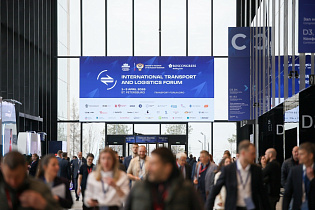
“On the second day of the ITLF, we transitioned to looking at a unified architecture for Eurasian transport links. The Northern Sea Route, international corridors, digital services, border infrastructure, and autonomous systems all shape a seamless logistics network. The key trend that Forum participants identified is the shift from isolated infrastructure facilities to the construction of a global system of routes, where the speed of cargo shipments is determined not merely by route capacity, but also by the quality of data exchange, digital services, and the standardization of protocols,” Adviser to the President of the Russian Federation and Executive Secretary of the ITLF Organizing Committee Anton Kobyakov said.
The discussions focused on the Trans-Arctic transport corridor, the synchronization of the Baikal–Amur Mainline and Trans-Siberian Railway with routes running to China, the EAEU digital space, the acceleration of border crossing procedures, and the introduction of autonomous transport systems. Another issue that was identified for future growth was the transition away from paper-based documentation toward the management of cargo flows based on real-time data.
Key figures of the day
• >RUB 10 trillion: investment portfolio for the Trans-Arctic Transport Corridor
• 186.9 million tonnes: record volume of Russia–China rail freight projected for 2025
• 35 million documents: already processed through the National Digital Transport and Logistics Platform
• 14 million vehicles: integrated into the GLONASS platform ecosystem
• 55 priority border crossing points: designated for technological modernization
• 38 hours → 3 hours: reduction in customs clearance time in Vladivostok
• 19 days → 15 days: time savings achieved through INTERTRAN technologies
• 8 days → 4 hours: reduction in border crossing time thanks to advance data exchanges
Eurasian Corridors and the New Geography of Trade
The key takeaway from this section is that the Eurasian transport system is entering a phase involving the consolidation of major logistics axes. The Northern Sea Route, Trans-Arctic Corridor, high-speed highways within the EAEU, the Russia–Mongolia–China routes, and the Union State corridors were discussed as integral components of a unified continental transport architecture. The focus has shifted from individual routes to their seamless integration with railways, seaports, inland terminals, and high-speed highways.
Facts and figures
• +70 million tonnes: projected increase in port capacity within the Northern Sea Route
• 180 → 270 million tonnes: target capacity growth for the Baikal–Amur Mainline and Trans-Siberian Railway by 2032
• Up to 50 train pairs per day: target throughput for the Zabaykalsk–Manzhouli border crossing
• 18,600 km: length of international highway corridors within the EAEU
• 1,767 km: length of Belarus’s toll road network
• +50%: increase in traffic intensity on high-speed highways
Key conclusions
1. The Northern Sea Route and the Trans-Arctic corridor are gaining a foothold as an independent logistical axis for Eurasia and demonstrating high resilience to external constraints.
2. The best economic benefits are generated not by any single route in isolation, but rather by the integration of railways, seaports, highways, and dry ports into a unified cargo flow system.
3. The Russia–China corridor still has maximum growth potential by synchronizing the Eastern railway network and land border crossings.
4. High-speed transport corridors within the EAEU are emerging as key infrastructure for economic integration and driving growth in tourism, industrial cooperation, and intra-union trade.
5. Investments in border crossings, logistics hubs, and dry ports continue to offer the quickest returns among all segments of transport infrastructure.
Digital Platforms and Seamless Logistics
The second key theme of the day was the transition to a common digital logistics space, where the primary value is generated through the instantaneous exchange of data among carriers, customs authorities, infrastructure operators, and government agencies. The National Digital Transport and Logistics Platform, e-shipping documents, the INTERTRAN system, digital route profiles, and integration with EAEU–China systems are collectively shaping a new paradigm, with logistics evolving into a data-driven system for managing cargo flows.
Facts and figures
• 30 paper document forms: still being at ports
• 5–8 documents: the standard set for a single shipment within the EAEU
• 13.5 million: units connected to the ERA–GLONASS emergency response system
• 55 border crossing points: currently being equipped with digital services
• Up to 10 minutes: target time for completing certain border control procedures
Key conclusions
1. The primary industry growth driver has been the complete elimination of paper-based documentation in international logistics.
2. Preliminary data exchange radically increases border throughput capacity without the need for large-scale new construction.
3. Standardized document formats within the EAEU are becoming a prerequisite for increasing cargo turnover within the EAEU.
4. Digital platforms need to be built based on open standards to ensure integration with foreign systems.
5. The next stage involves transitioning from the digitalization of documents to the intelligent, real-time management of cargo flows.
Transport of the Future: Autonomous Systems, Workforce, and Sovereign Technologies
Synopsis
The third session of the day focused on technological sovereignty in the transport sector: autonomous systems, digital airspace, transport mathematics, AI algorithms, and a new workforce model for the industry. Competitiveness is no longer defined by the sheer number of pilot projects, but rather by the speed at which platform-based solutions are scaled up, and by the training of engineers who are capable of designing intelligent transport systems.
Facts and figures
• 20,000 flights: performed by drones in Yugra in 2025
• >CNY 400 billion: economic impact of smart transport in China
• 7 new HSR corridors: included in India’s national plan
• 30–40%: reduction in maintenance and repairs costs via digitalization
• Up to 50%: reduction in unplanned equipment downtime
Key conclusions
1. Unmanned systems are evolving from an experimental technology into an integral part of transport infrastructure.
2. Allied and international digital standards for low-altitude traffic management have the potential to become an exportable product.
3. Sovereign AI-driven route management systems are the next stage after the digitalization of documentation workflows.
4. Transport universities are broadening their role as training hubs for architects of intelligent transport systems.
5. The primary source of long-term efficiency is the synergy between engineering education, AI, and applied transport mathematics.
Daily summary: The second day of the Forum saw a shift from discussing isolated infrastructure solutions to assembling a cohesive Eurasian transport model in which physical corridors, digital platforms, autonomous technologies, and workforce training are viewed as a unified system of development.
The International Transport and Logistics Forum was held in accordance with directives from President of the Russian Federation Vladimir Putin about enhancing the global competitiveness of Russia’s transport corridors, including the implementation of decrees that align with the country’s national goals through both 2030 and 2036.
The Forum was organized by the Ministry of Transport of the Russian Federation with the support of the Government of the Russian Federation and managed by the Roscongress Foundation.
For more about the Forum and its business programme, please visit transport-forum.org.