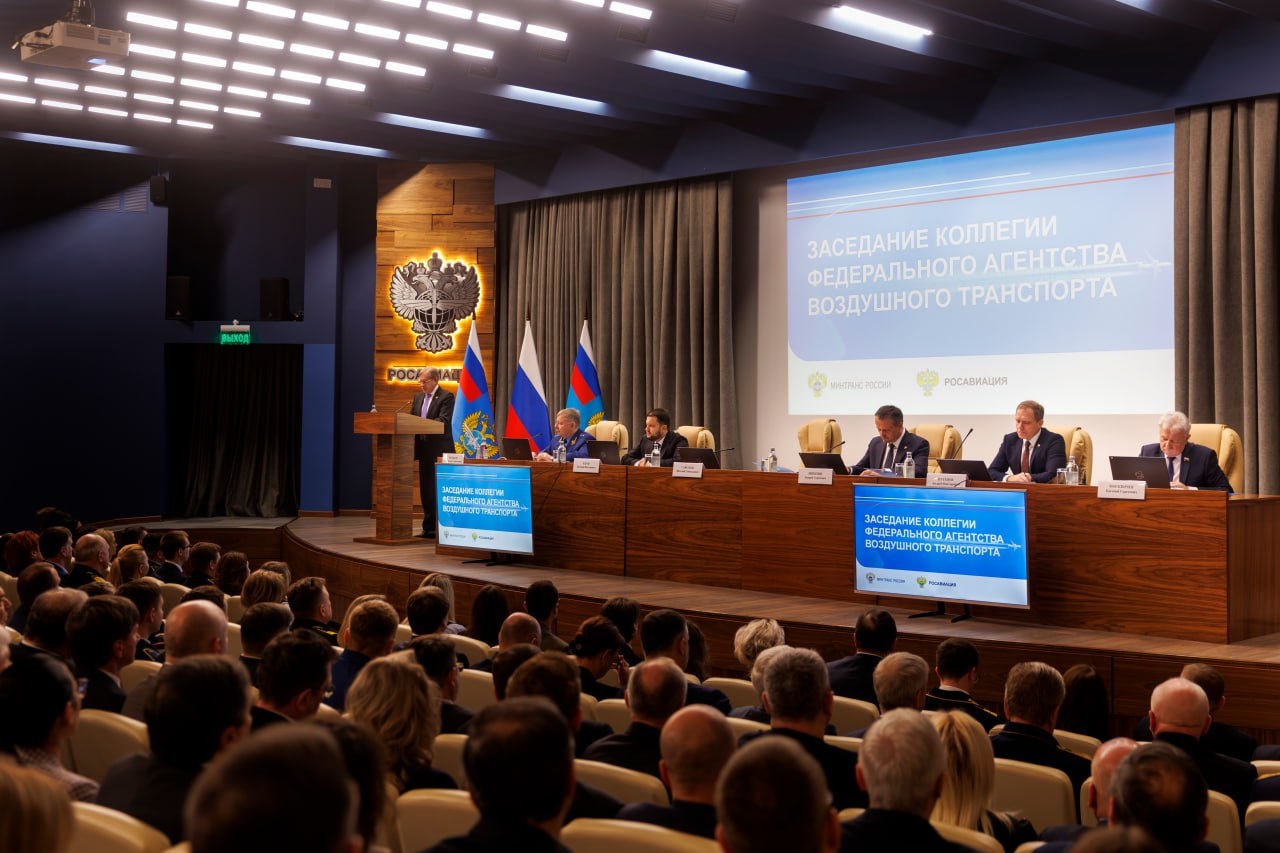
Deputy Prime Minister of the Government of the Russian Federation Vitaly Savelyev took part in the latest board meeting of the Federal Air Transport Agency (Rosaviatsia). The event was also attended by Minister of Transport Andrey Nikitin, leadership from relevant committees of the Federation Council and the State Duma, representatives of the professional aviation community, as well as veterans and honored workers of the industry.
The Deputy Prime Minister emphasized that aviation remains the main instrument of the country’s connectivity and its international presence. “The industry has proven its resilience to external challenges. In 2025, Russian airlines carried about 109 million passengers. First of all, I would like to thank airline teams and airport staff for the results achieved and for their coordinated work,” Vitaly Savelyev noted.
In accordance with the President’s directive, aviation mobility among the population must be increased by 2030. To achieve this goal, air transport infrastructure is being actively developed. The Deputy Prime Minister recalled that under the national project “Efficient Transport System,” new facilities were commissioned at seven airfields in 2025. By 2030, at least 75 airfields are planned to be reconstructed or built.
“It is important to use modern mechanisms of public-private partnership. Within the framework of the national project, three concession agreements out of the planned twenty-eight have already been signed. It is necessary to ensure the implementation of the plan jointly with airport holding companies and regional authorities,” Vitaly Savelyev stressed.
A key factor in fulfilling the President’s task of increasing aviation mobility is the renewal of airline fleets with domestically produced aircraft. The TU-214 aircraft has already been certified. The regional aircraft IL-114 is at the final stage of certification. Certification flights of the Superjet and MC-21 aircraft equipped with domestically produced PD-8 and PD-14 engines are being conducted intensively.
Special attention is also being given to the development of unmanned technologies. Russia is currently among the world leaders in their implementation. As part of the national project “Unmanned Aircraft Systems,” the regulatory framework is being developed and conditions are being created for the safe and large-scale use of drones across various sectors of the economy.
In 2025, class “H” airspace was introduced. This became an important step for the further development of the industry and for the integration of unmanned systems into a unified airspace. Over the past year, the intensity of drone flights increased by 20 percent.
Source: Government of the Russian Federation.