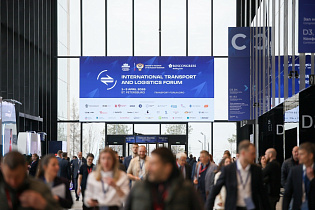
The first International Transport and Logistics Forum, which will continue until 3 April, is now underway in St. Petersburg. The objective of the ITLF is to create the opportunity for global partners to engage in dialogue on the development of the world’s transport system in an era of geopolitical change.
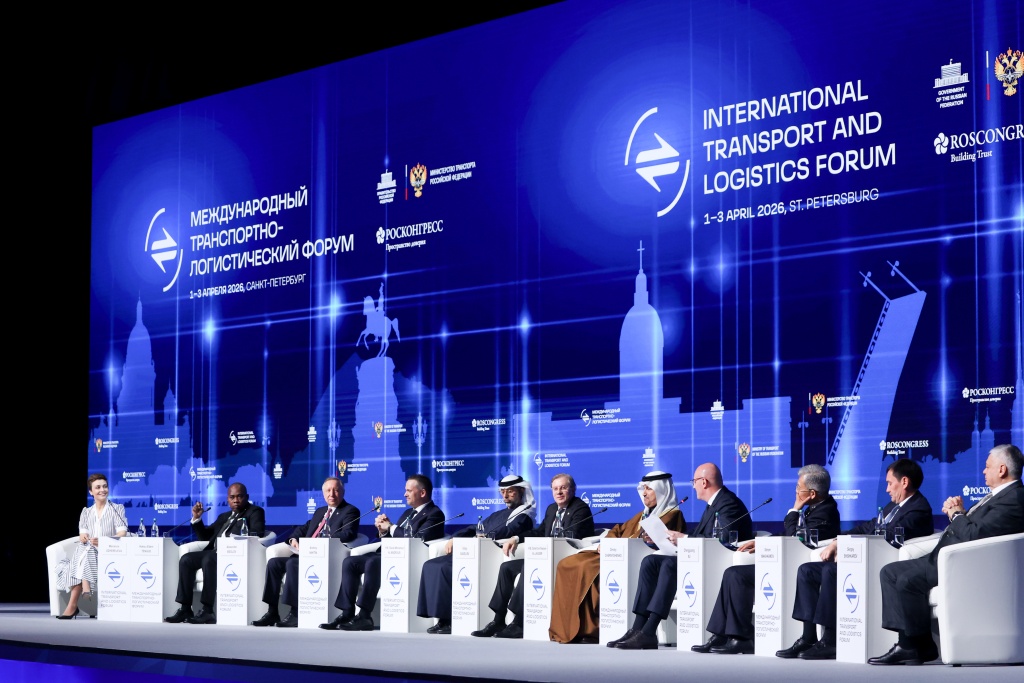
The Forum kicked off with the plenary session ‘World Transport Corridors: Integration and Seamless Logistics’, which was attended by Deputy Prime Minister of the Russian Federation Vitaly Saveliev, Deputy Prime Minister of the Russian Federation Dmitry Chernyshenko, Minister of Transport of the Russian Federation Andrey Nikitin, Minister of Transport and Logistics Services of the Kingdom of Saudi Arabia H.E. Saleh bin Nasser Al-Jasser, Minister of Energy and Infrastructure of the United Arab Emirates H.E. Suhail Mohammed Al Mazrouei, Minister of Transport of the Republic of Uzbekistan Ilkhom Makhkamov, Minister Delegate for Maritime Economy of the Ministry of Maritime Economy, Fisheries, and Coastal Protection of the Togolese Republic Kokou Edem Tengue, Vice Minister of Transport of the People’s Republic of China Xu Chengguang, Governor of St. Petersburg Alexander Beglov, and Chairman of the Board of Directors of the Delo Group of Companies Sergey Shishkarev.
As the global order changes and the economy and technology move forward with increasing speed, international transport corridors expand beyond their traditional role to become increasingly important as tools for ensuring predictability, security, and international economic ties.
Deputy Prime Minister of the Russian Federation Vitaly Saveliev touched on Russia’s strategic role as a link between North, South, East, and West and spoke in detail about the development of the five main international transport corridors that pass through the country.
“As markets in the Global South continue to develop over the coming years, the International North–South Transport Corridor will only continue to gain in importance. In the past four years, we have significantly upgraded infrastructure in the corridor and improved the organization of transport along its routes,” he said.
The North–South Transport Corridor significantly reduces the distance between Russia’s Baltic ports and South Asia, making it almost 50% shorter than the route that traverses the Suez Canal and reducing the time needed from 35–45 days to just 15–20. Last year, around 21.5 million tonnes of cargo passed through the corridor, 39% more than five years ago.
The Deputy Prime Minister also highlighted the ongoing development of the historic Eastern Railway Domain rail artery connecting to Siberia and the Far East and raising its capacity from just 98 million tonnes in 2013 to 180 million tonnes in 2024. The third phase of the Eastern Railway Domain project kicked off last year, with contracts awarded for the construction of impressive, capital-intensive infrastructure projects like the Severomuysky, Kodarsky and Kuznetsovsky tunnels and a bridge across the Amur River.
Saveliev also drew attention to the rapid development of the Northern Sea Route and the broader Trans-Arctic Transport Corridor. “Today’s Northern Sea Route stretches beyond the Kara Gate and the Bering Strait to St. Petersburg and Vladivostok. It’s more than a commercial route – it’s a way of keeping our country connected year-round,” he said. Planned cargo traffic on the Northern Sea Route is expected to reach between 70 and 109 million tonnes by 2030, with work continuing on the port infrastructure and icebreaker fleet to accommodate the increase in traffic.
“President Vladimir Putin has identified priorities for scientific and technological development. Russia’s Scientific and Technological Development Strategy states that technology should help ensure transport connectivity in our country. We are also instructed to maintain our leadership positions in the development of our own technologies: on land, at sea, and in the air, including unmanned and autonomous systems,” Dmitry Chernyshenko said.
He also spoke of the importance of keeping apace with global technological trends in logistics and the use of artificial intelligence, robots, and drones, as well as a commitment to sustainable development.
Nearly RUB 140 billion has been earmarked for research and development over the next three years as part of the Industrial Support for Transport Mobility national project, with the lion’s share going to research and development in aviation and shipbuilding.
The Deputy Prime Minister also reported that the Russian Ministry of Labour predicted a need for some 220,000 qualified specialists in Russia’s transport sector by 2032: “We are creating more national scholarships at universities and colleges every year, with over 130,000 this academic year alone. Approximately 170,000 applicants were admitted to Russian universities and colleges last year, with roughly 128,000 graduating and entering the work force. More than 8,500 international students from over 100 countries also studied at Russian transport universities.”
46 specialized clusters were created in 34 regions in partnership with more than 100 different companies to meet industry needs as part of the Professionalism federal project.
Minister of Transport of the Russian Federation Andrey Nikitin touched on the areas in the industry that needed to continue to develop, emphasizing the importance of eliminating constraints on infrastructure, following through with digitalization, and expanding international cooperation.
According to Nikitin, who cited the construction of the Moscow–St. Petersburg high-speed railway and the additional opportunities it would create for freight transport and the development of port infrastructure, the elimination of infrastructure constraints continues to be a priority. “We have the budget for it and clear plans and intend to go about eliminating existing infrastructure constraints in a systematic way over the coming years,” he said.
Nikitin spoke in particular about the seamless nature of digital processes and the development of a National Digital Transport and Logistics Platform, whose electronic consignment notes for rail and air transport had already been successfully implemented, with plans to expand to road transport on 1 September. A registry of carriers and freight forwarders is in the process of being created, with Nikitin suggesting digitalization and electronic documents would reduce the border crossing process to a mere 10 minutes.
Driverless transport and driverless trucks have the potential to shorten delivery times between St. Petersburg and Kazan from 58 to 24 hours. Driverless trains, trams, and other innovative solutions are being adopted across Russia as a legislative framework is developed for their adoption on a large scale.
As regards international cooperation, Nikitin emphasized the need to build the transport system on the principles of openness and cooperation and reiterated Russia’s willingness to share its technologies and experience with partners and develop joint projects in logistics and digital platforms.
When his turn came to speak, Alexander Beglov drew attention to St. Petersburg’s 10 Development Priorities programme. “We are part of our country’s great transport system, and we are proud of the many major projects we are working on. One such landmark project is the high-speed railway between St. Petersburg and Moscow, which will reduce travel time to just 2 hours and 15 minutes, a truly impressive achievement whose launch in 2028 we await with great expectation,” he said.
Plans are also being rolled out to expand port infrastructure, rail transport, and air travel that would strengthen St. Petersburg’s role as a major transportation hub.
Xu Chengguang spoke of China’s experience of reform and opening up of the last forty years and the powerful infrastructure it has produced for transport and logistics. “China’s development plan for the next five years includes sweeping measures to transform the national transport system and improve quality of service. We view existing challenges as opportunities to diversify trade and logistics,” he said. The Vice Minister also added that sharing best practices in transport and logistics could become the basis for mutually beneficial cooperation. China is ready to share its experience and implement joint projects that will contribute to the economic development of all parties involved.
Minister of Transport and Logistics Services of the Kingdom of Saudi Arabia H.E. Saleh bin Nasser Al-Jasser spoke of Saudi Arabia’s transport strategy, which seeks to transform the country into a global logistics hub. “The projects already implemented at our ports, airports, and roads testify to the health of existing infrastructure,” he said. “The sustainability of the entire logistics system is one of our primary goals. We’ve invested in modern technology, all our port terminals and airports are equipped with cutting-edge solutions, and we have new routes planned to improve connectivity and strengthen relations with other countries.”
Minister of Energy and Infrastructure of the United Arab Emirates H.E. Suhail Mohammed Al Mazrouei spoke of his country’s decision to invest significant money in the development of its railway infrastructure, with work already underway to connect to Oman by rail and open up new opportunities for freight transportation to Africa and Asia.
“We continue to invest in the development of our country’s logistics network and alternative routes. Russia is an important exporter of raw materials, and development in its regions will contribute to economic growth across the globe. Central Asia is also emerging as a key player, and we are investing in the region’s infrastructure and connecting China to the global economy through Russia and the Middle East,” he said.
Ilkhom Makhkamov spoke of Uzbekistan’s experience with the digital transformation of logistics. “We are working to create a unified transport space in Central Asia with digital transport documents that will speed up the passage of international cargo through our territory,” he said. “Uzbekistan is actively digitalizing every aspect of the transport sector and is open to integration with international transport corridors, particularly important in the context of the challenges currently facing global logistics. We understand that there is no single, universal transport corridor, and so we intend to be a part of multiple routes.”
Kokou Edem Tengue spoke of the importance of understanding the African perspective on changing maritime routes as the situation around the Suez Canal and the Strait of Hormuz creates new opportunities for West Africa.
The Port of Lomé, the largest container port in Sub-Saharan Africa, handles approximately 30 million tonnes of goods annually, and its importance for the region is difficult to overstate. “We are actively working with Mali, Burkina Faso, and Niger, the Port of Lomé is a key logistics hub for the landlocked nations of the Sahel,” he said. “It should be noted that Africa relies on chemical fertilizers and grain produced in Russia. We believe that the Port of Lomé could be a part of new sea routes between Africa and Russia.”
The International Transport and Logistics Forum is being held in response to the call of the Russian President to ensure the ability of Russia’s transport corridors to compete internationally and fulfill the Executive Order on the Development Goals of the Russian Federation through 2030 and for the Future Until 2036.
The International Transport and Logistics Forum has been organized by the Ministry of Transport of the Russian Federation and managed by the Roscongress Foundation with the support of the Government of the Russian Federation.
For more information about the Forum and business programme, please visit transport-forum.org.