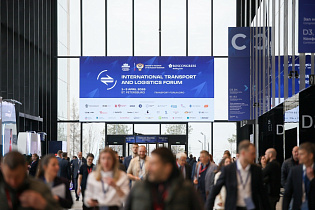
The idea was tabled by the Ministry of Transport, Ministry of Industry and Trade, and Ministry of Science and Higher Education at a panel session entitled ‘New Mobility: How Technology is Changing the World’, held as part of the first International Transport and Logistics Forum. The competition, named after the preeminent inventor and educator, one of the founders of engineering and transport education in Russia, is intended to become a platform for scientific and engineering teams, scientists, and students from around the world who are working on cutting-edge solutions for the transport sector.
Speakers at the event included Minister of Transport of the Russian Federation Andrey Nikitin, Minister of Science and Higher Education of the Russian Federation Valery Falkov, Minister of Industry and Trade of the Russian Federation Anton Alikhanov, Chairman of the Board of Sirius Federal Territory and Head of the Talent and Success Foundation Elena Shmeleva, General Director of Transmashholding Kirill Lipa, President of the Russian Academy of Transport and Chairman of the Board of Directors of Sinara-Transport Machines Alexander Misharin, President of AVTOVAZ Maxim Sokolov, President of the Eurasia International Corporation Feng Yaou, and Minister of State for Special Initiatives of the Republic of Ghana Emmanuel Kwadwo Agyekum. The discussion was moderated by President of the Kurchatov Institute National Research Centre Mikhail Kovalchuk.
New mobility technologies are turning into the main driver of the restructuring of the global economy and everyday life. Autonomous driving, transport electrification, and the integration of artificial intelligence are blurring the boundaries between the physical and digital worlds, creating a seamless transportation environment. Today, Russian developers are offering comprehensive solutions for smart cities: from driverless vehicle control systems to hi-tech infrastructure for electric and hydrogen transport.
Andrey Nikitin pointed to the fact that the transport system both ensures the movement of people and goods, and influences the development of cities and towns. The lack of necessary transport links can cause the degradation of localities, while developing these areas contributes to economic growth.
One of the key steps on this path is the transition to digital technologies. Digitalization allows artificial intelligence to be integrated into management processes, improving the quality and effectiveness of decisions. For example, the introduction of driverless technologies in road construction allows for real-time process monitoring, creating digital twins of objects. Decades from now, we will still be able to see how the road was built, what materials were used.
Another important area is autonomous transport. “Today, we are moving from experiments and trials to the formation of a fundamentally new way of life. It will be based on digital platforms and unified standards, as the entire system must operate on principles that everyone can understand. And this, of course, must be safe for people. We also need to adhere to cybersecurity requirements. A critical mass of knowledge and experience is accumulating that allows us to clearly see the path ahead and move forward with confidence,” Andrey Nikitin said.
The Minister of Transport also noted that his agency is becoming one of the largest clients for scientific research. The education system and research infrastructure must adapt to the new challenges.
He further stated that supporting talent and increasing human resources potential will be the key to the development of the transport industry for years and decades to come. “For us, it is important to be able to identify and replicate bold, innovative, and ambitious ideas put forward by engineers. We must support experienced and emerging innovators from Russia and abroad at every stage – from product testing to subsequent implementation. And this is precisely the goal of the Agustín de Betancourt International Engineering Competition, which we are launching alongside the Ministry of Trade and the Ministry of Science and Higher Education,” Nikitin concluded.
Anton Alikhanov noted that most of the near- and long-term transport development objectives are included in the Industrial Support for Transport Mobility national project. The absolute priority of all the industries involved, Alikhanov added, is to ensure that all engines, main components, and systems are manufactured in-house. A major programme aimed at establishing technological independence for air transport is being completed. “Major modifications of the Tupolev Tu-204 have been approved, and it will soon enter serial production. We are planning to certify the Ilyushin Il-114 this coming May, and the Superjet by the end of the year. Mass-produced aircraft are already being assembled at factories, and engine designers are readying the production of the PD-14, PD-8, and TV7-117 to meet future delivery volumes. I should note that the PD-8 will also serve as the basis for the re-motorization of the Beriev Be-200ChS and the Mil Mi-26 heavy transport helicopter. In addition, certification of the Klimov VK-800 engine and the Aerosila AV-901 propeller is expected to be completed by December, and the Baikal aircraft soon after that,” the Minister explained.
Further, the Mi-171A2/A3 and Ka-32 with VK-2500 engines are also being manufactured, and the light Ansat and Mi-34 helicopters with VK-650V engines (already certified) are undergoing testing. The plan is to use this engine as part of a hybrid electric power system for small aircraft with vertical or short takeoff and landing configurations, as well as heavy transport UAVs.
Over the past five years, ship builders have completed more than 90 ships for tourist and scheduled services. Ten high-speed catamarans, the Kotlin and Sommers, have been delivered to operators, along with 37 river trams, and 14 more on the way.
Anton Alikhanov reported that Russian manufacturers produce all types of traction and rolling stock for the development of rail transport. “In the summer of 2027, two lead trains are scheduled to be delivered for testing on the high-speed railway. We expect to receive a certificate of conformity in March 2028. By that time, Ural Locomotives will already have the capacity to produce around 140 carriages for high-speed electric trains, and roughly 100 for rapid trains,” he added.
In his speech, Valery Falkov spoke about the development of a network of advanced engineering schools. Fifty of these schools have already opened their doors, and another 50 will do so by 2030. “Numerous schools serve the needs of the transport industry. A prime example is the school opened by Transmashholding and Russian Railways at Emperor Alexander I St. Petersburg State Transport University,” the Minister explained.
According to Falkov, leading engineering schools serve as talent magnets, platforms for experimentation, and the ultimate hub for interaction between universities and employers. They create unique conditions for the development of innovative projects, allowing students to bring their ideas to life almost immediately.
Another key programme mentioned by Falkov is Priority 2030, in which the Russian University of Transport plays a leading role. The programme helps universities strengthen their positions in a competitive environment and provides additional resources for implementing unique scientific and educational projects.
The International Transport and Logistics Forum is being held at the instructions of the President of the Russian Federation to ensure the global competitiveness of Russia’s transport corridors. This includes implementing decrees as part of Russia’s national goals up to 2030 and for the period up to 2036.
The Forum is organized by the Ministry of Transport of the Russian Federation and operated by the Roscongress Foundation, with the support of the Government of the Russian Foundation.
More information on the Forum and its business programme is available on the website: transport-forum.org.